Pages

Powered By Blogger

Tuesday, 8 May 2012

Oil Platform


www.kamps.com.my


An oil platform, also referred to as an offshore platform or, somewhat incorrectly, oil rig, is a large structure with facilities to drill wells, to extract and process oil and natural gas, and to temporarily store product until it can be brought to shore for refining and marketing. In many cases, the platform contains facilities to house the workforce as well.
Depending on the circumstances, the platform may be fixed to the ocean floor, may consist of an artificial island, or may float.
Remote subsea wells may also be connected to a platform by flow lines and by umbilical connections; these subsea solutions may consist of one or more subsea wells, or of one or more manifold centres for multiple wells.
Types
Larger lake- and sea-based offshore platforms and drilling rigs are some of the largest moveable man-made structures in the world. There are several types of oil platforms and rigs:

Fixed platforms

  A fixed platform base 
These platforms are built on concrete or steel legs, or both, anchored directly onto the seabed, supporting a deck with space for drilling rigs, production facilities and crew quarters. Such platforms are, by virtue of their immobility, designed for very long term use (for instance the Hibernia platform). Various types of structure are used, steel jacket, concrete caisson, floating steel and even floating concrete. Steel jackets are vertical sections made of tubular steel members, and are usually piled into the seabed. Concrete caisson structures, pioneered by the Condeep concept, often have in-built oil storage in tanks below the sea surface and these tanks were often used as a flotation capability, allowing them to be built close to shore (Norwegian fjords and Scottish firths are popular because they are sheltered and deep enough) and then floated to their final position where they are sunk to the seabed. Fixed platforms are economically feasible for installation in water depths up to about 1,700 ft (520 m).

[edit]Compliant towers

These platforms consist of slender flexible towers and a pile foundation supporting a conventional deck for drilling and production operations. Compliant towers are designed to sustain significant lateral deflections and forces, and are typically used in water depths ranging from 1,200 to 3,000 feet (370 to 910 m).

[edit]Semi-submersible platform

These platforms have hulls (columns and pontoons) of sufficient buoyancy to cause the structure to float, but of weight sufficient to keep the structure upright. Semi-submersible platforms can be moved from place to place; can be ballasted up or down by altering the amount of flooding in buoyancy tanks; they are generally anchored by combinations of chain, wire rope or polyester rope, or both, during drilling or production operations, or both, though they can also be kept in place by the use of dynamic positioning. Semi-submersibles can be used in water depths from 200 to 10,000 feet (60 to 3,000 m).

[edit]Jack-up drilling rigs

 jackup rig
Jack-up Mobile Drilling Units (or jack-ups), as the name suggests, are rigs that can be jacked up above the sea using legs that can be lowered, much like jacks. These MODUs (Mobile Offshore Drilling Units) are typically used in water depths up to 400 feet (120 m), although some designs can go to 550 ft (170 m) depth. They are designed to move from place to place, and then anchor themselves by deploying the legs to the ocean bottom using a rack and pinion gear system on each leg.

[edit]Drillships

A drillship is a maritime vessel that has been fitted with drilling apparatus. It is most often used for exploratory drilling of new oil or gas wells in deep water but can also be used for scientific drilling. Early versions were built on a modified tanker hull, but purpose-built designs are used today. Most drillships are outfitted with a dynamic positioning system to maintain position over the well. They can drill in water depths up to 12,000 ft (3,700 m).[5]

[edit]Floating production systems

The main types of floating production systems are FPSO (floating production, storage, and offloading system). FPSOs consist of large monohull structures, generally (but not always) shipshaped, equipped with processing facilities. These platforms are moored to a location for extended periods, and do not actually drill for oil or gas. Some variants of these applications, called FSO (floating storage and offloading system) or FSU (floating storage unit), are used exclusively for storage purposes, and host very little process equipment. This is one of the best sources for having floating production.

[edit]Tension-leg platform

TLPs are floating platforms tethered to the seabed in a manner that eliminates most vertical movement of the structure. TLPs are used in water depths up to about 6,000 feet (2,000 m). The "conventional" TLP is a 4-column design which looks similar to a semisubmersible. Proprietary versions include the Seastar and MOSES mini TLPs; they are relatively low cost, used in water depths between 600 and 4,300 feet (180 and 1,300 m). Mini TLPs can also be used as utility, satellite or early production platforms for larger deepwater discoveries.


[edit]Gravity-based structure

A GBS can either be steel or concrete and is usually anchored directly onto the seabed. Steel GBS are predominantly used when there is no or limited availability of crane barges to install a conventional fixed offshore platform, for example in the Caspian Sea. There are several steel GBS in the world today (e.g. offshore Turkmenistan Waters (Caspian Sea) and offshore New Zealand). Steel GBS do not usually provide hydrocarbon storage capability. It is mainly installed by pulling it off the yard, by either wet-tow or/and dry-tow, and self-installing by controlled ballasting of the compartments with sea water. To position the GBS during installation, the GBS may be connected to either a transportation barge or any other barge (provided it is large enough to support the GBS) using strand jacks. The jacks shall be released gradually whilst the GBS is ballasted to ensure that the GBS does not sway too much from target location.

[edit]Spar platforms

 Spar Platform
Spars are moored to the seabed like TLPs, but whereas a TLP has vertical tension tethers, a spar has more conventional mooring lines. Spars have to-date been designed in three configurations: the "conventional" one-piece cylindrical hull, the "truss spar" where the midsection is composed of truss elements connecting the upper buoyant hull (called a hard tank) with the bottom soft tank containing permanent ballast, and the "cell spar" which is built from multiple vertical cylinders. The spar has more inherent stability than a TLP since it has a large counterweight at the bottom and does not depend on the mooring to hold it upright. It also has the ability, by adjusting the mooring line tensions (using chain-jacks attached to the mooring lines), to move horizontally and to position itself over wells at some distance from the main platform location. The first production spar was Kerr-McGee'sNeptune, anchored in 1,930 ft (590 m) in the Gulf of Mexico; however, spars (such as Brent Spar) were previously used as FSOs.
Eni's Devil's Tower located in 5,610 ft (1,710 m) of water, in the Gulf of Mexico, was the world's deepest spar until 2010. The world's deepest platform is currently the Perdido spar in the Gulf of Mexico, floating in 2,438 meters of water. It is operated by Royal Dutch Shell and was built at a cost of $3 billion.
The first truss spars were Kerr-McGee's Boomvang and Nansen. The first (and only) cell spar is Kerr-McGee's Red Hawk.

[edit]Normally unmanned installations (NUI)

These installations (sometimes called toadstools) are small platforms, consisting of little more than a well bay, helipad and emergency shelter. They are designed to be operated remotely under normal conditions, only to be visited occasionally for routine maintenance orwell work.

[edit]Conductor support systems

These installations, also known as satellite platforms, are small unmanned platforms consisting of little more than a well bay and a small process plant. They are designed to operate in conjunction with a static production platform which is connected to the platform by flow lines or by umbilical cable, or both.


Article from Wikipedia, the free encyclopedia


Contact us:

Website: www.kamps.com.my


Notice: Photos are used for illustrations purposes only and does not in any way express ownership or any title to the same.

Disclaimer

"All images are sourced from the internet and are in the public domain. We claim no credit for any images or videos featured on this site unless otherwise noted. All visual content is copyright to it's respectful owners. If you own rights to any of the images or videos, and do not wish them to appear on this site, please contact us via e-mail and they will be promptly removed. We are not responsible for content on any external website, and a link to such site does not signify endorsement. Information on this site may contain errors or inaccuracies; the site's proprietors do not make warranty as to the correctness or reliability of the site's content."


Tuesday, 14 February 2012

PIGS Pipeline Inspection Gadget


www.kamps.com.my


Pipeline Inspection Gauge
A pipeline inspection gauge or "PIG" in the pipeline industry is a tool that is sent down a pipeline and propelled by the pressure of the product in the pipeline itself. There are four main uses for pigs:
  1. Physical separation between different liquids being transported in pipelines;
  2. Internal cleaning of pipelines;
  3. Inspection of the condition of pipeline walls (also known as an Inline Inspection (ILI) tool);
  4. Capturing and recording geometric information relating to pipelines (e.g. size, position).
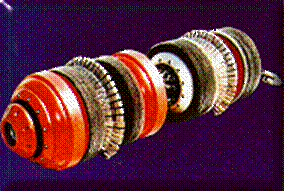
Poly pig
One kind of pig is a soft, bullet shaped polyurethane foam plug that is forced through pipelines to separate products to reduce mixing. There are several types of pigs for cleaning. Some havetungsten studs or abrasive wire mesh on the outside to cut rust, scale, or paraffin deposits off the inside of the pipe. Others are plain plastic covered polyurethane.
Inline inspection pigs use various methods for inspecting a pipeline. A sizing pig uses one (or more) notched round metal plates that are used as gauges. The notches allow different parts of the plate to bend when a bore restriction is encountered. More complex systems exist for inspecting various aspects of the pipeline. Intelligent pigs, also called smart pigs, are used to inspect the pipeline with sensors and record the data for later analysis. These pigs use technologies such as MFL and ultrasonics to inspect the pipeline. Intelligent pigs may also use calipers to measure the inside geometry of the pipeline.
Intelligent pig/smart pig
In 1961, the first intelligent pig was run by Shell Development. It demonstrated that a self-contained electronic instrument could traverse a pipe line while measuring and recording wall thickness. The instrument used electromagnetic fields to sense wall integrity. In 1964 Tuboscope ran the first commercial instrument. It used MFL technology to inspect the bottom portion of the pipeline. The system used a black box similar to those used on aircraft to record the information.
Capacitive sensor probes are used in the process of detecting defects in polyethylene pipe gas pipeline. These probes are attached to the pig in which the pig is sent through the polyethylene pipe that will detect any defects in the outside of the pipe wall. This is done by using a triple plate capacitive sensor in which the electrostatic waves are propagated outware through the pipe's wall. Any change in dielectric material will result in a change in capacitance.[8] Testing was conducted by NETL DOE research lab at the Battelle West Jefferson’s Pipeline Simulation Facility (PSF) near Columbus, Ohio.[9]

Etymology
The original pigs were made from straw wrapped in wire used for cleaning. They made a squealing noise while traveling through the pipe, sounding to some like a pig squealing, which gave pigs the name.[1](Disputed: 'PIG' is an acronym or backronym derived from the initial letters of the term 'Pipeline Inspection Gauge' or possibly 'Pipeline Inspection Gizmo' or 'Pipeline Internal Geometry' or 'Pipeline Inspection Gadget')


Pigging
Pig launcher & receiver
Pigging in the context of pipelines refers to the practice of using pipeline inspection gauges or 'pigs' to perform various maintenance operations on a pipeline. This is done without stopping the flow of the product in the pipeline.
These operations include but are not limited to cleaning and inspecting of the pipeline. This is accomplished by inserting the pig into a 'pig launcher' (or 'launching station') - a funnel shaped Y section in the pipeline. The launcher / launching station is then closed and the pressure driven flow of the product in the pipeline is used to push it along down the pipe until it reaches the receiving trap - the 'pig catcher' (or receiving station).
Butterfly valve
If the pipeline contains butterfly valves, the pipeline cannot be pigged. Ball valves cause no problems because the inside diameter of the ball can be specified to be the same as that of the pipe (assuming they are full bore valves).
Pigging has been used for many years to clean larger diameter pipelines in the oil industry. Today, however, the use of smaller diameter pigging systems is now increasing in many continuous and batch process plants as plant operators search for increased efficiencies and reduced costs.
Pigging can be used for almost any section of the transfer process between, for example, blending, storage or filling systems. Pigging systems are already installed in industries handling products as diverse as lubricating oils, paints, chemicals, toiletries, cosmetics and foodstuffs.
Pigging process
Pigs are used in lube oil or painting blending: they are used to clean the pipes to avoid cross-contamination, and to empty the pipes into the product tanks (or sometimes to send a component back to its tank). Usually pigging is done at the beginning and at the end of each batch, but sometimes it is done in the midst of a batch, e.g. when producing a premix that will be used as an intermediate component.
Pigs are also used in oil and gas pipelines: they are used to clean the pipes but also there are "smart pigs" used to measure things like pipe thickness and corrosion along the pipeline. They usually do not interrupt production, though some product can be lost when the pig is extracted. They can also be used to separate different products in a multiproduct pipeline.

  Pigging in Production Enviroment                                                                                                 

Product and time saving

PLC based pigging control systems.
A major advantage of piggable systems is the potential resulting product savings. At the end of each product transfer, it is possible to clear out the entire line contents with the pig, either forwards towards the receipt point, or backwards to the source tank. There is no requirement for extensive line flushing.
Without the need for line flushing, pigging offers the additional advantage of a much more rapid and reliable product changeover. Product sampling at the receipt point becomes faster because the interface between products is very clear, and the old method of checking at intervals, until the product is on-specification, is considerably shortened.
Pigging can also be operated totally by a programmable logic controller (PLC).


Environmental issues
Pigging has a significant role to play in reducing the environmental impact of batch operations. Traditionally, the only way that an operator of a batch process could ensure a product was completely cleared from a line was to flush the line with a cleaning agent such as water or a solvent or even the next product. This cleaning agent then had to be subjected to effluent treatment or solvent recovery. If product was used to clear the line, the contaminated finished product was downgraded or dumped. All of these problems can now be eliminated due to the very precise interface produced by modern pigging systems.


Safety considerations
Bi-directional pig
Pigging systems are designed so that the pig is loaded into the launcher, which is pressured up to launch the pig into the pipeline through a kicker line. In some cases, the pig is removed from the pipeline via the receiver at the end of each run. All systems must allow for the receipt of pigs at the launcher, as blockages in the pipeline may require the pigs to be pushed back to the launcher. Most of the time, systems are designed to pig the pipeline in either direction.
The pig is pushed either with an inert gas or a liquid; if pushed by gas, some systems[2] can be adapted in the gas inlet in order to ensure pig's constant speed, whatever the pressure drop is. The pigs must be removed, as many pigs are rented, pigs wear and must be replaced, and cleaning pigs push contaminants from the pipeline such as wax, foreign objects, hydrates, etc., which must be removed from the pipeline. There are inherent risks in opening the barrel to atmosphere and care must be taken to ensure that the barrel is depressured prior to opening. If the barrel is not completely depressured, the pig can be ejected from the barrel and operators have been severely injured when standing in front of an open pig door. When the product is sour, the barrel should be evacuated to a flare system where the sour gas is burnt. Operators should be wearing a self-contained breathing apparatus when working on sour systems.
A few pigging systems utilize a "captive pig", and the pipeline is only opened up very occasionally to check the condition of the pig.[3] At all other times, the pig is shuttled up and down the pipeline at the end of each transfer, and the pipeline itself is never opened up during process operation. These systems are not common.
Intelligent pig
Intelligent pigging
The electronics are sealed to prevent leakage of the pipeline product into the electronics since products can range from highly basic to highly acidic and can be of extremely high temperature. Many pigs use specific materials according to the product in the pipeline. Power for the electronics is provided by onboard batteries which are also sealed. Data recording may be by various means ranging from analog tape, digital tape, or solid state memory in more modern digital units.Modern intelligent pigs are highly sophisticated instruments that vary in technology and complexity by the intended use and by manufacturer. An intelligent pig, or smart pig, includes electronics and sensors that collects various forms of data during the trip through the pipeline.
Pig uses magnetic flux leakage
The technology used to accomplish the service varies by the service required and the design of the pig, each pigging service provider may have unique and proprietary technologies to accomplish the service. Surface pitting and corrosion, as well as cracks and weld defects in steel/ferrous pipelines are often detected using magnetic flux leakage (MFL) pigs. Other "smart" pigs use electromagnetic acoustic transducers to detect pipe defects. Caliper pigs can measure the "roundness" of the pipeline to determine areas of crushing or other deformations. Some smart pigs can combine technologies such as MFL and Caliper into a single tool. Recent trials of pigs using acoustic resonance technology have been reported.[4]
During the pigging run the pig is unable to directly communicate with the outside world due to the distance underground or underwater and/or materials that the pipe is made of. For example, steel pipelines effectively prevent any reliable radio communications outside the pipe. It is therefore necessary that the pig use internal means to record its own movement during the trip. This may be done by gyroscope-assisted tilt sensors, odometers and other technologies[5]. The pig will record this positional data so that the distance it moves along with any bends can be interpreted later to determine the exact path taken.
Pig detector
Location verification is often accomplished by surface instruments that record the pig’s passage by either audible, magnetic, or gravinometric[citation needed] (or other) means. The sensors will record when they detect passage of the pig (time-of-arrival); this is then compared to the internal record for verification or adjustment. The external sensors may have GPS capability[6] to assist in their location. A few pig passage indicators transmit the pig’s passage, time and location, via Orbcomm satellite uplink.[7] The pig itself cannot use GPS as the metal pipe blocks satellite signals.
After the pigging run has been completed, the positional data from the external sensors is combined with the pipeline evaluation data (corrosion, cracks, etc.) from the pig to provide a location-specific defect map and characterization. In other words, the combined data will tell the operator the location and type and size of each pipe defect. This is used to judge the severity of the defect and help repair crews locate and repair the defect quickly without having to dig up excessive amounts of pipeline. By evaluating the rate of change of a particular defect over several years, proactive plans can be made to repair the pipeline before any leakage or environmental damage occurs.
The inspection results are typically archived (perhaps in Pipeline Open Data Standard format) for comparison with the results of later pigging runs on the same pipeline.
Article from Wikipedia, the free encyclopedia


Contact us:

Website: www.kamps.com.my


Notice: Photos are used for illustrations purposes only and does not in any way express ownership or any title to the same.

Disclaimer

"All images are sourced from the internet and are in the public domain. We claim no credit for any images or videos featured on this site unless otherwise noted. All visual content is copyright to it's respectful owners. If you own rights to any of the images or videos, and do not wish them to appear on this site, please contact us via e-mail and they will be promptly removed. We are not responsible for content on any external website, and a link to such site does not signify endorsement. Information on this site may contain errors or inaccuracies; the site's proprietors do not make warranty as to the correctness or reliability of the site's content."


Sunday, 12 February 2012

Valve


www.kamps.com.my


A valve is a device that regulates, directs or controls the flow of a fluid (gases, liquids, fluidized solids, or slurries) by opening, closing, or partially obstructing various passageways. Valves are technically pipe fittings, but are usually discussed as a separate category. In an open valve, fluid flows in a direction from higher pressure to lower pressure.
The simplest, and very ancient, valve is simply a freely hinged flap which drops to obstruct fluid (gas or liquid) flow in one direction, but is pushed open by flow in the opposite direction.
Valves are used in a variety of contexts, including industrial, military, commercial, residential, and transport. The industries in which the majority of valves are used are oil and gas, power generation, mining, water reticulation, sewage and chemical manufacturing.
In daily life, most noticeable are plumbing valves, such as taps for tap water. Other familiar examples include gas control valves on cookers, small valves fitted to washing machines and dishwashers, safety devices fitted to hot water systems, and valves in car engines. In nature, veins acting as valves are controlling the blood circulation; heart valves control the flow of blood in the chambers of the heart and maintain the correct pumping action.
Valves play a vital role in industrial applications ranging from transportation of drinking water to control of ignition in a rocket engine.
Valves may be operated manually, either by a handle, lever or pedal. Valves may also be automatic, driven by changes in pressure,temperature, or flow. These changes may act upon a diaphragm or a piston which in turn activates the valve, examples of this type of valve found commonly are safety valves fitted to hot water systems or boilers.
More complex control systems using valves requiring automatic control based on an external input (i.e., regulating flow through a pipe to a changing set point) require an actuator. An actuator will stroke the valve depending on its input and set-up, allowing the valve to be positioned accurately, and allowing control over a variety of requirements.


Article from Wikipedia, the free encyclopedia


Contact us:

Website: www.kamps.com.my


Notice: Photos are used for illustrations purposes only and does not in any way express ownership or any title to the same.

Disclaimer

"All images are sourced from the internet and are in the public domain. We claim no credit for any images or videos featured on this site unless otherwise noted. All visual content is copyright to it's respectful owners. If you own rights to any of the images or videos, and do not wish them to appear on this site, please contact us via e-mail and they will be promptly removed. We are not responsible for content on any external website, and a link to such site does not signify endorsement. Information on this site may contain errors or inaccuracies; the site's proprietors do not make warranty as to the correctness or reliability of the site's content."

Friday, 10 February 2012

Kamps Energy (M) Sdn Bhd: Kamps Energy

Kamps Energy (M) Sdn Bhd: Kamps Energy: Follow @kampsenergy Kamps Energy (M) Sdn Bhd company was incorporated under Malaysian law with the objectives to participate...